Manager Companion: Financial Fluency for Advisors
Built by My Retirement Network®. Teaching advisors to speak human.
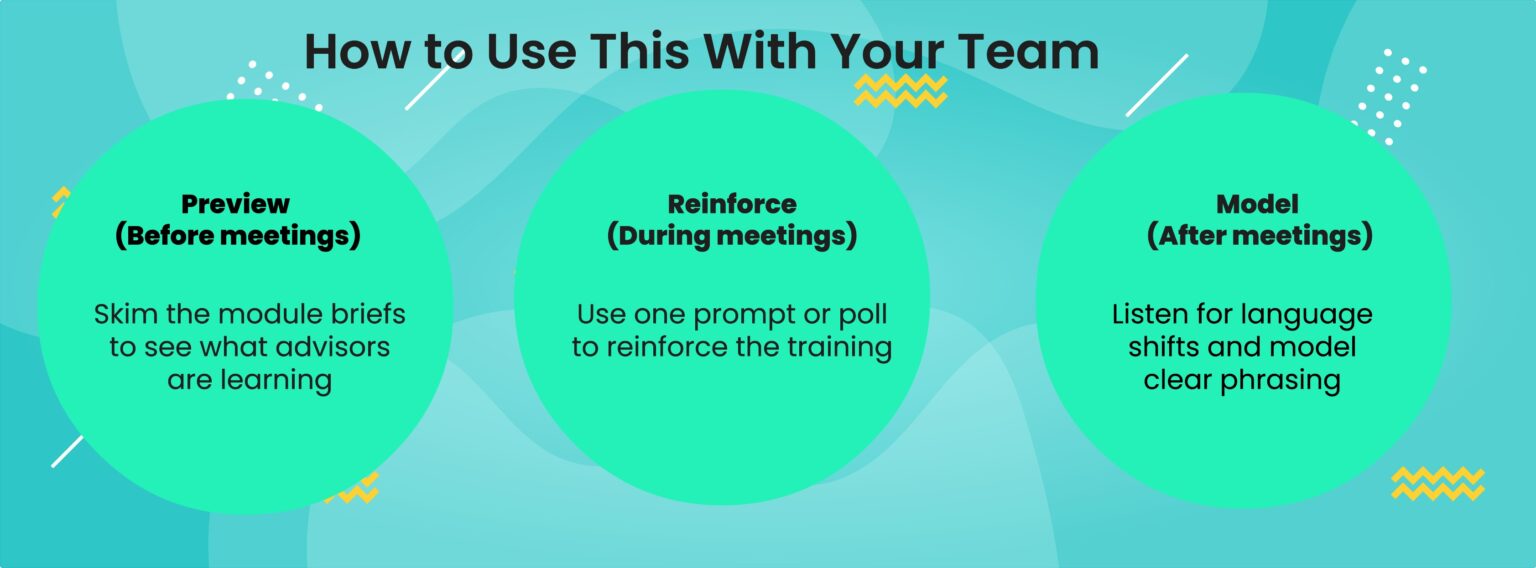
This page is designed to give you visibility into what advisors are learning in Financial Fluency for Advisors without requiring you to complete the modules yourself. Use it to reinforce key ideas in meetings, listen for shifts in advisor language, and connect the training to your existing development process.
Manager Tools
Use these in team meetings, 1:1s, or debriefs after client interactions.
- What part of the modules felt most uncomfortable or unfamiliar, and why?
• Where have you noticed clients disengaging or going quiet recently?
• What phrase do you say automatically that might be jargon to a client?
• When a client hesitates, do you usually slow down or explain more?
• What conversation this week would have gone differently if you slowed the pace?
• Which client questions are hardest to answer simply?
• What did you notice about your own pacing after watching the modules?
• Where do you feel most confident explaining something? Where do you rush?
Simple ways to keep the concepts alive without extra training sessions.
- Ask advisors to rewrite one client explanation in plain language and share it with the team.
• Have advisors listen for silence, nodding, or delayed follow-up in meetings and note when it happens.
• Pick one common phrase (e.g., “tax efficient” or “optimize”) and challenge the team to replace it for a week.
• During meeting prep, ask: “What part of this will be hardest for the client to process?”
• After meetings, ask advisors what they think the client would repeat to a spouse.
• Encourage advisors to pause after explanations and ask a check-in question before continuing.
• Use one team meeting per month to share a “clarity win” or “clarity miss.”
These can be used in Zoom polls, meetings, or internal surveys.
- I tend to speed up when I feel confident explaining something (Agree / Disagree)
• I notice when clients are confused before they say anything (Always / Sometimes / Rarely)
• I usually respond to hesitation by explaining more (Yes / No)
• I feel comfortable slowing down even when time is tight (Yes / No)
• I use the same explanation for the same concept with most clients (Yes / No)
• Clients often ask follow-up questions after I explain a strategy (Often / Sometimes / Rarely)
• I check for understanding in every meeting (Always / Sometimes / Rarely)
Managers can model this in meetings or encourage advisors to try it verbatim.
- “Let me pause for a second — what part of this feels least clear?”
• “I’m going to slow this down, because this part matters.”
• “Before I go on, tell me what you’re hearing so far.”
• “This is one of those ideas that makes sense on paper but can feel uncomfortable in real life.”
• “We can walk through this in a different way if that helps.”
• “You don’t need to decide today — I want you to leave feeling clear, not rushed.”
• “If you were explaining this to someone at home, what would you say?”
Learning Briefs for Each Module: Top 10 Highlights & Takeaways for Managers
- Most client breakdowns happen before advice is evaluated. Even good plans can be rejected if clients do not fully understand them emotionally or cognitively.
- Advisors are trained to be technically fluent, while clients are not trained to receive technical language. This creates a language gap that advisors often cannot see because they are too fluent to notice it.
- Advisors speak planning language; clients speak life language. When advisors translate life decisions into planning language too quickly, clients disconnect.
- Clients are processing new terminology, money anxiety, logic, and consequences at the same time, which dramatically slows their ability to absorb information compared to the advisor’s thinking speed.
- Advisors often mistake nodding, silence, or polite agreement for understanding, when these are frequently signs of overload or confusion.
- When advisors feel confident, they tend to talk faster, add more detail, and explain more, which usually makes clarity worse rather than better.
- The module identifies common jargon advisors use without realizing it, including terms like tax-efficient, optimize, diversify, drawdown, allocation, and sequence risk, which clients may recognize but not truly understand.
- Advisors are encouraged to shift from explaining concepts to translating meaning by slowing down, using fewer words, checking for understanding, and anchoring conversations to real-life decisions.
- Pacing is introduced as a trust behavior, not a personality trait. When advisors slow down, clients feel safer, ask better questions, and retain more.
- The core message is that communication skill is not separate from technical skill. Communication is what turns knowledge into action, and advisors are not just experts — they are guides.
- Clarity functions as a psychological safety signal. When clients feel clarity, they feel safe, and safety increases engagement, questions, and follow-through.
- Clients decide whether they trust an advisor before they evaluate the advice. Tone, pacing, and word choice shape trust faster than strategy does.
- Confusion triggers stress, and stressed clients default to inaction, delay, or silent disengagement rather than decision-making.
- Advisors often mistake polished delivery for clarity, even when the client is actually lost.
- Silence, polite nodding, delayed follow-up, or surface-level questions are often signs of confusion rather than agreement.
- Advisors are encouraged to replace “Does that make sense?” with questions that invite honesty, such as asking what felt least clear or whether another explanation would help.
- Trust increases when advisors slow the pace, pause intentionally, and invite clients into the conversation rather than delivering information at them.
- The module introduces the clarity–confidence loop, showing how clear explanations build confidence, confidence leads to better questions, and better questions lead to better decisions.
- Advisors are taught to frame strategies around outcomes and client goals rather than mechanics, because clients care more about control, stability, and meaning than technical detail.
- The core takeaway is that advisors are not just explaining strategies — they are creating the emotional conditions that make action possible.
- Social Security conversations are difficult not because of math, but because they combine emotion, misinformation, politics, and fear. Clients often arrive anxious and overwhelmed before the conversation even begins.
- The goal of this module is to teach advisors how to explain Social Security clearly and calmly so clients can make decisions with confidence, not to teach rules, calculators, or optimization strategies.
- Advisors are taught to reframe Social Security as a base layer of retirement income that provides stable, inflation-adjusted income for life, rather than something to “time” or “beat.”
- Positioning Social Security as income insurance helps clients see it as a planning tool instead of a guessing game or political issue.
- Claiming age is framed as one of the most important decisions clients control, with clear explanations of trade-offs between claiming early, at full retirement age, or delaying, and how those choices affect lifetime and survivor income.
- Advisors are encouraged to move away from break-even math alone and toward conversations about income security, flexibility, and peace of mind, which are the real drivers of client decisions.
- The module shows advisors how to address emotional fears directly, such as dying early, missing out, wanting to “just take it,” or fearing system collapse, using empathy and facts instead of dismissal.
- Advisors are taught a simple two-step response to objections: reflect the concern first to validate it, then reframe with grounded, accurate information to restore calm.
- Language and pacing techniques are emphasized, including using round numbers, everyday language, clear sequencing, and better check-in questions that invite honesty rather than polite agreement.
- The core takeaway is that clients remember how these conversations felt more than the numbers themselves, and that confidence, tone, and structure are what build trust and follow-through.
- Debt conversations are emotionally charged because they carry shame, fear, guilt, and identity, not just numbers. Clients often enter these conversations already feeling exposed, defensive, or overwhelmed.
- Advisors are trained to focus on rates, balances, and payoff math, but clients experience debt as a personal story shaped by life events, stress, and survival decisions.
- The module teaches advisors to lower the emotional temperature before addressing numbers by normalizing debt as common and separating the client’s identity from their financial situation.
- Common shame signals include deflection, over-explaining, disengagement, silence, and strained agreement. These are not resistance behaviors, but self-protection behaviors.
- Language choices strongly influence whether clients open up or shut down. Advisors are taught to replace judgmental or directive phrasing with collaborative, permission-based language that invites honesty.
- Advisors learn how to explain high-interest debt clearly by anchoring the cost in real dollars and timelines, not just APRs, and by showing opportunity cost without fear tactics.
- Debt explanations are framed around possibility, not punishment, by showing what cash flow freedom enables rather than focusing only on what the debt costs.
- The module demonstrates how small changes in language can completely shift client engagement, using a side-by-side rewrite of a credit card conversation to show the difference between pressure and partnership.
- Advisors are taught to present payoff strategies as choices rather than mandates, recognizing that psychological sustainability often matters more than mathematical optimization.
- The core takeaway is that debt conversations are not about fixing behavior, but about creating safety, clarity, and agency so clients feel capable of taking action and sustaining change.
- Forecasting is often intimidating for clients because it feels abstract, technical, and disconnected from their real lives, even though it is one of the most important planning tools advisors use.
- Advisors are trained to think in projections and probabilities, but clients experience forecasts as guesses about their future, which can trigger fear, skepticism, or disengagement.
- The module reframes forecasting as a decision-support tool, not a prediction tool, and emphasizes that the purpose is to improve choices today, not to guarantee outcomes tomorrow.
- Clients struggle most when forecasts are presented as charts without context; visuals without narrative increase confusion rather than clarity.
- Advisors are taught to lead forecasting conversations with purpose first, explaining why the forecast matters before showing numbers, assumptions, or visuals.
- The module shows how to translate projections into real-life meaning by anchoring results to lifestyle, trade-offs, and time horizons instead of percentages and probabilities.
- Advisors are encouraged to explain assumptions slowly and explicitly, because hidden assumptions are the primary reason clients mistrust projections.
- When clients push back on forecasts, the module teaches advisors to treat resistance as uncertainty, not disagreement, and to invite conversation instead of defending the model.
- Advisors are shown how to use forecasting to create confidence and momentum by presenting scenarios as choices clients can influence, not outcomes that happen to them.
- The core takeaway is that good forecasting is less about accuracy and more about helping clients feel oriented, informed, and capable of making decisions under uncertainty.
- Roth conversion conversations break down at the communication level, not the technical level, because clients experience them as abstract, risky, and emotionally loaded decisions rather than logical tax strategies.
- Advisors often lead with tax brackets, projections, and optimization logic, which triggers anxiety and resistance before clients understand the purpose of the strategy.
- Clients experience Roth conversions as paying a cost now for a benefit later, making the decision emotionally difficult even when the math is favorable.
- The module shows how default explanations overload clients by combining tax theory, forecasting, and emotional discomfort into a single conversation.
- Advisors are taught to rewrite Roth explanations using client-first language that removes jargon, affirms concerns, and frames the strategy as a choice rather than a directive.
- Permission-based language is introduced to replace authoritative recommendations with collaborative exploration that builds trust and openness.
- Advisors learn to sequence Roth explanations in three parts: current reality, what the strategy does, and what it creates, allowing clients to process each layer clearly.
- The module teaches advisors to introduce the logic of a Roth conversion before naming it, so clients attach meaning before encountering technical terms.
- Analogies, pacing, and simple visuals are used to make the strategy tangible and connected to real-life outcomes rather than abstract tax benefits.
- The core takeaway is that Roth conversions succeed when advisors translate the strategy into human terms, pace the conversation, and create psychological safety for decision-making.
- Follow-up messages are not administrative tasks; they are one of the primary ways advisors reinforce clarity, trust, and momentum after meetings, because clients rarely act on advice at the moment it is delivered.
- Most advisors unintentionally weaken their follow-ups by sending vague “checking in” emails, long walls of text, or messages with unclear next steps, which shifts effort back onto the client and increases inaction.
- Effective follow-ups function as a second wave of clarity, helping clients remember what was decided, why it matters, and what happens next, especially when memory and confidence fade after meetings.
- Advisors are taught to use structure as a communication tool: brief context, a short recap, clear action steps, optional educational reinforcement, and a warm open-ended close that keeps the relationship moving.
- The module introduces the “Mini Recap” technique, a short 3–5 line summary that anchors decisions and next steps without overwhelming clients, and reinforces that listening well is more powerful than explaining more.
- Mini Recaps work because they reduce cognitive load, give clients language they can reuse with spouses or family members, and create a reliable rhythm clients begin to expect and trust.
- Subject lines, closings, and calls to action are framed as trust signals, not formatting details; clear subject lines improve engagement, warm closings keep dialogue open, and explicit next steps prevent delay and confusion.
- Advisors are shown how tone must flex by client type, with examples for analytical, big-picture, time-crunched, and anxious clients, emphasizing that resonance matters as much as accuracy.
- Written follow-ups are positioned as one of the few tangible artifacts of advisor value, often forwarded to spouses or family members, making them a silent but powerful extension of the advisor’s voice and professionalism.
- The core takeaway for managers: improving follow-ups reduces follow-up chasing, increases client follow-through, strengthens trust between meetings, and turns routine emails into consistent education and reinforcement tools.
- Most communication breakdowns are not caused by bad advice or bad intent, but by blind spots created by expertise. Advisors often don’t notice breakdowns because the client’s confusion is quiet, polite, and delayed.
- Miscommunication usually erodes trust slowly rather than creating an immediate conflict. Clients disengage through silence, delay, or reduced follow-through rather than direct confrontation.
- The first major red flag is jargon and over-explaining. Advisors often use technical terms that carry assumed meaning, causing clients to stop asking questions even when they are lost.
- Over-explaining increases cognitive overload. When advisors answer questions the client didn’t ask or layer too many details at once, clients retain less, not more.
- Advisors are taught to reduce jargon by translating rather than simplifying, using everyday language, clarifying intent, and delivering explanations in layers so the client controls how deep the conversation goes.
- The second red flag is missing emotional cues. Clients often signal discomfort, fear, or confusion through silence, nervous humor, repetition, or body language changes rather than words.
- Advisors are encouraged to respond to emotional cues before technical ones, acknowledging the feeling underneath the question rather than immediately solving the problem with data or strategy.
- The third red flag is rushing or skipping pauses. When advisors move too quickly, fill silence, or transition topics without checking in, clients fall behind without saying so.
- The module teaches real-time course correction techniques, including naming confusion, reframing mid-sentence, slowing pace, using metaphors, breaking ideas into smaller steps, and inviting the client to explain concepts back in their own words.
- The closing focus is loop-closing habits: summarizing decisions out loud, confirming action items, inviting reflection before ending meetings, previewing next steps, and ending with affirming statements that reinforce confidence and momentum.
- Ethical communication failures rarely come from dishonesty and more often come from technically accurate language that creates misunderstanding.
- Advisors have an ethical obligation not just to disclose information, but to ensure clients truly comprehend what they are agreeing to.
- The module explains how omission and framing can distort client perception even when facts are correct and disclosures are made.
- Advisors are shown how tone, pacing, and emotional context can influence client decisions without the advisor realizing it.
- The line between persuasion and manipulation is defined by intent, balance, transparency, and pressure, not by outcomes alone.
- Case studies demonstrate how ethical breakdowns occur when clarity is sacrificed for efficiency or confidence.
- Advisors learn how vulnerability, grief, stress, and life transitions reduce client processing capacity and increase advisor influence.
- The CFP® Code and Standards are tied directly to communication behaviors, not just technical compliance requirements.
- Part 2 focuses on boundary risks, including role confusion, emotional overreach, and blurred lines between education and advice.
- The core takeaway is that ethical advising requires ongoing awareness of how language, tone, and timing shape client autonomy and consent.